Affinity Photo Photo Editor App For Mac
Nov 18, 2019 It has powerful functionality for things like non-destructive photo editing, seamless photo stitching, HDR, and complex image composition. Affinity Photo was originally developed for Mac only, but Serif has since released a Windows-compatible version as well. Affinity offers plenty of editing tools and supports more than 15 file types. Jan 20, 2020 Affinity Photo redefines the boundaries for professional photo editing software on the Mac. With a meticulous focus on workflow it offers sophisticated tools for enhancing, editing and retouching your images in an incredibly intuitive interface with all the power and performance you need. Affinity Photo. DxO OpticsPro for Photos. CyberLink PhotoDirector 10. Fotor Photo Editor. Movavi Photo Editor for Mac. For semi-pro and even pro-level photo editing, Affinity Photo is a bona fide bargain and a true competitor for Photoshop. Here's our Affinity Photo 1.5 for Mac review. Jun 23, 2017 Affinity Photo (App Store: is a desktop class photo editing app for iPad that may quench your thirst for Photoshop. Subscribe http:/. Jun 04, 2017 Full-featured “Photoshop for iPad”, rock solid on iOS 11.1.2 and iPad Pro 10.5. Affinity Photo for iOS really is exactly what Serif claims it to be: a fully functional Photoshop for the iPad. On my iPad Pro 10.5 it is smooth and solid with no significant bugs and close to zero crashes.
- Affinity Photo Update Mac
- Affinity Photo Photo Editor App For Mac Windows 10
- Affinity Photo Free Download Mac
Photo editing programs are hugely popular on Mac. There are lots of opinions on which are the best. With the Photos app on Mac, some of the best editing programs have extensions so you can quickly jump in to edit your photos without having to first load them into their full-service apps. If you want to quickly touch something up or add some filters, highlights, and corrections, these great apps are perfect for your in-Photos for Mac experience.
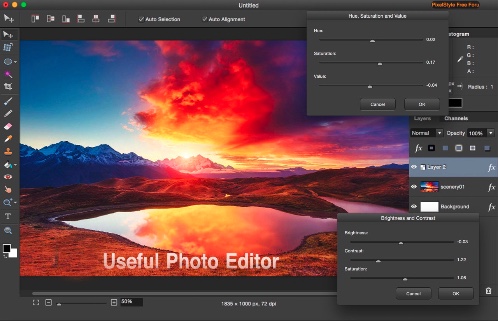
Pixelmator
Chances are you've probably heard of Pixelmator. Often lauded as the ultimate Adobe alternative for Mac users, this full-featured photo editor (and its even more impressive Pro version was built specifically for macOS, allowing you to really harness the power of your Mac's unique capabilities.
With Pixelmator, you can make adjustments, add effects, and do pretty much anything else you'd expect to be able to do with an image editing program. However, you don't even have to open Pixelmator to reap its benefits — once downloaded, the app also offers an extension called Pixelmator Retouch that allows you to retouch your favorite shots without ever needing to leave the native Photos app. This includes blemish repair, complex object removal, cloning, light adjustments, color adjustments, and the ability to blur or sharpen your images.
Affinity Photo
Like Pixelmator, Affinity Photo is a pro-level photo editor often praised for its sophistication and versatility. In fact, its iPad version actually won App of the Year back in 2017. Affinity is engineered to enhance the workflow of professional photographers, designers, and digital artists, but don't let that scare you away if you're interested — its interface and tools are intuitive enough for a beginner to use, making it super easy to amp up your images no matter your skill level.
These are fakes and you should use them at your own risk. Well.you can’t!CCleaner is not available for iOS, unfortunately. Ccleaner for ipad. Any apps you see with similar names in the app store are not the original CCleaner from Piriform.
Within the app, you can do everything from editing RAW images to creating multi-layer compositions (and much, much more). The fun doesn't stop there, though. Affinity Photo also boasts six extensions that can be used within the Photos app: Affinity Develop, Retouch, Liquify, Miniature, Monochrome, and Haze Removal. Each pretty much does as its moniker describes. For instance, Monochrome allows you to create artistic black and white images, while Retouch lets you correct images by removing red-eye, healing blemishes, and getting rid of pesky extra objects. The only one that doesn't have a function easily discernible from its name is Miniature, which allows you to give your photos a cool depth-of-field blur.
Polarr Photo Editor
Polarr is a good option for those who want something like Lightroom, but would prefer to be able to try it before committing. Polarr has a free version that you can grab and use, and if you like it, you can opt for the Polarr Pro subscription, which is $2.49/mo or $24 a year. There's also a one-time purchase option for $70 if you'd rather not subscribe.
With Polarr, you'll get many of the same functions as Lightroom, and it also works with both RAW and JPEG images, so there's no issue with compatibility. However, Polarr has a much cleaner and simpler interface that is lightning fast, while still providing you with all of the tools you need for a perfect photo. You have custom filters, batch exporting, dual lens effects and adjustments, layers and blending modes, and more. Polarr is highly customizable, so you can make it entirely yours.
The Photos extension for Polarr brings many of the editing tools in Polarr right into Photos itself, so you don't even need to have Polarr open to edit with it. Edits you make get rendered instantaneously with no lag, so you don't need to wait. The only drawback is that this is destructive editing, so your original won't be available once you save any changes.
Photoscape X
For those who want a fun and free photo editor, Photoscape X is a great option to consider.
Photoscape X combines a photo editor, batch editor, photo viewer, cut-outs, collage combiner, animated GIFs creator, and more, all into one single package. It also works with RAW images too, so no worries there. The photo editor part of Photoscape X has all of the standard tools that you need, and the cut outs make it super simple to remove the background from images. And with things like batch edit, collages, and animated GIFs, it's easy to deal with multiple photos at once.
The extension allows you to harness the editing power of Photoscape X directly in the Photos app, without having to have Photoscape X open. Of course, you won't be able to do things like creating animated GIFs or collages this way, but for basic photo editing, it's great.
Photolemur 3
What if you want great-looking photos but don't have the time to edit them all individually? Then Photolemur has the Photos extension for you.
Photolemur's strength lies in its artificial intelligence, which automatically enhances any image without you having to do any legwork. With Photolemur, it analyzes images and then identifies their weaknesses, making adjustments to them with powerful and advanced algorithms. There's even a new feature called Face Finish, which will automatically smooth skin, remove imperfections, enhances eyes, and whitens up teeth. Portraits will never have looked better, and you don't need to lift a finger. There is even batch processing with Photolemur, so you can spend less time editing and more time shooting photos.
Luminar 4
Luminar 4 is the latest iteration of the powerful photo editor and browser from Skylum. It works as a standalone app or as a plugin or extension for both Adobe and Apple products, like Photos and Photoshop.
With Luminar 4, there are a ton of intelligent algorithms to help make your photo editing life easier than ever before. The AI Sky Replacement can replace the entire sky in your photo to change the overall mood of your image, which was a challenging task before, but it's now entirely automated. There is even AI Skin and Portrait Enhancer features to get amazingly realistic results on your portraits that are done outside or in a studio, all through artificial intelligence. Luminar 4 can even detect specific areas in a photo that could be better and enhances them without altering the rest of the photo. Sources of sunlight can be moved around your image too, which can give you a totally new feel to a photo.
There are a ton of other intelligent features behind Luminar 4, but those are the most impressive ones. This is a powerful photo editor that can do amazing things in just a few clicks, and it helps with your overall productivity and creativity as well.
Aurora HDR 2019
High Dynamic Range (HDR) may not be appeal to everyone, but there is no doubt that it can definitely improve an image. With Aurora HDR 2019, you're getting a powerful quantum HDR engine powered by artificial intelligence, so it only gives you the highest quality HDR.
With Aurora HDR, you get creative LUT mapping, polarizing filters, color toning, HDR Denoise, dodge and burn, details enhancer, and much more. And if you're concerned about doing a lot of editing work to get the perfect HDR, no problem! Aurora does all of the heavy lifting for you and gives you a beautifully enhanced photo in seconds. There are over 80 different HDR presets that you can use from acclaimed photographers like Trey Ratcliff, Serge Ramelli, Randy Van Duinen, and more. There are also advanced features like layers and masking, batch processing, and RAW support.
What are your favorites?
These are some of our favorite photo editors on the Mac that utilize the Photos extension. Do you have a favorite? Let us know what you're using in the comments!
January 2020: Added Photolemur 3, Luminar 4, and Aurora HDR 2019 to the list.
We may earn a commission for purchases using our links. Learn more.
alipayiOS 14 AliPay support will open up Apple Pay to over a billion users
Apple's iOS 14 operating system will bring support to AliPay, opening up mobile payments to potentially more than a billion customers.
The first fully featured, truly professional photo editing tool for iPad
It’s a rare event when an app can completely change how you use a device. When the iPhone was released in 2007 and then when the original iPad was released in 2010, our world’s drastically began the move from desktop to mobile workspaces. Over the past decade, app developers have been innovating their methods to keep up with how people work with the mobile technologies and it’s really become the focus for most people. The mobile devices are quickly catching up to and surpassing the power of many stationary workstations so it’s only fitting that the software is modified to work alongside them.
One of my primary uses of a computer is to edit photos and design graphics. For many, many years, I honed my craft using Photoshop like so many graphic designers did. When the tide began to turn, and Adobe changed their model for purchase to a subscription-based one, I made the decision to look for a Mac-based product that would operate in the same manner and would still provide me with the tools to create breathtaking images and designs. It was a tireless search because there were many developers who were trying to make a Photoshop alternative for professional users, but there were lots of failures. Finally, two years ago, I found Affinity Photo for Mac. It’s a beautiful, powerful photo editor that operates in very much the same way that Photoshop does. The wonderful thing about that is that there is a very small learning curve for proficient users of PS.
I said all that to say this — Affinity Photo is now available on the iPad.
When this announcement was made earlier this month at WWDC that Affinity Photo for iPad would be released soon, I was ecstatic. That rare moment where a device changes completely was about to happen for me. You see, I love the mobility that an iPad affords me, but I still find it limiting because I’ve never been able to find a photo editor that is powerful enough for me. I really love having the tools that professional-grade photo editing software provides and you just don’t get that with a lot of the options out there. The release of Affinity Photo has changed the way I work with my iPad. Before installing it, I would use my iPad for writing, but when it came to editing any photos, I would switch off to my MacBook Pro. This really makes it difficult to have an efficient workflow. Since I’ve acquired Affinity Photo, I’ve been able to be much more self-sufficient on my iPad.
Affinity Photo for iPad is built on the exact same platform and backend as the Mac version. The developer, Serif Labs, made sure the app was fully optimized to take advantage of the iPad’s hardware and touch capabilities. One of the improvements made for the iPad version was that all the rendering, adjustments, brushes and filters have been fully hardware accelerated using Metal to ensure the best possible performance. Affinity Photo is a very impressive photo editor and it has a lot of features that make it a first-class app. Here is just a sampling of some of them.
- Full support for unlimited layers, layer groups, adjustment layers, filter layers and masks
- Open RAW and other images in a dedicated pre-processing workspace
- View histograms, blown highlights, shadows and tones as well as EXIF information
- Massive collection of effects available, including blurs, distortions, tilt-shift, shadows, glows, lighting
- Intuitive selection brush and refinement makes selections simple, even down to strands of hair
- Dedicated Liquify persona gives freehand control over warps, twirls, pinch, punch, and turbulence
- Huge library of painting, drawing, textures and professional DAUB brushes included
- Professional-grade file standards
- Open, edit and save Photoshop® PSD files
- RGB, CMYK, HDR, Greyscale and LAB color spaces
- End-to-end CMYK workflow with ICC color management and OCIO support
- Full 16 and 32-bit per channel editing
- Work with all standard formats like PNG, TIFF, JPG, GIF, SVG, EPS, EXR, HDR, PSD, and PDF
The iPad version of Affinity Photo has not let me down and is very much like it’s older Mac brother. It’s built to look and feel like the desktop app so you’re not fumbling around trying to learn a dumbed down mobile version of a desktop app. Having a full photo editing platform that really gives me that opportunity to size, resize, use layers, and so much more, is incredible. I used to find myself getting aggravated attempting to get images just right and I would find myself using my iPad less and less. Now, it’s like a brand new device for me. When I use Affinity Photo on the iPad Pro, I feel in control of my creations and don’t have to interrupt my workflow. I feel as if I could travel much lighter now and not worry if I will need my laptop on my day or weekend trips.
Affinity Photo Update Mac
For testing purposes, I tried Affinity Photo for iPad on two different iPad models — the iPad Pro 12-inch and the new iPad Pro 10.5-inch. I decided to do two main functions – coloring, which used the Apple Pencil and then some basic color shifts with an image. This was the main method of testing for Affinity Photo for iPad because I already had experience with the app in general, I really wanted to try it with iPad-specific features. The Apple Pencil is probably my favorite accessory for the iPad Pro so it was really great to be able to use it with an advanced photo editor like Affinity Photo. It’s a precision tool with a precision app. Bing search app for mac. I downloaded an image of a peacock and used the pencil to color in parts of it. I will admit that it will take practice to use the pencil with Affinity Photo. Since this was my first foray with this app and this accessory, I didn’t color inside the lines the entire time. Affinity Photo has all kinds and sizes of brushes and I had to find a good balance as I was adding color to the peacock.
The second test I did was to adjust the color on an image of a backlit keyboard. I wanted it to pop a bit more and appear more vibrant than the original image. So, I adjusted the exposure, saturation, contracts, and vibrance settings. Since this was sort of a trial and error test, I just moved the sliders around until the colors were what I wanted them to be. It’s a completely different user experience on the iPad because instead of using a mouse or trackpad to make your adjustments, you are using the pencil or your finger to slide across the screen. It honestly starts feeling like something out of Star Trek and I love it.
Finally, the main reason I feel that Affinity Photo is a game-changer for content creators like me is because you have full use of layers. This feature more than any others is what has kept me from being able to fully edit graphics on the iPad. Now that Affinity Photo has brought that to the a mobile platform, I have complete freedom to edit photos and make brand new creations. In the example below, you will see the before image and the after with multiple layers of edits included. I had the first image, but wanted to isolate the horse in it and place it on a different background. Then, I wanted to add another object into the new image. So, I found the hut and cut it out of its existing background so that I could add it in. I also had a black layer so that I could erase or paint out parts of images that didn’t need to be there. To me, having the ability to have multiple layers to an image really makes for a professional-grade photo editing app.
Affinity Photo has really become my go-to photo editing platform on my Mac over the past couple of years. It’s got everything I need and completely replaces Adobe’s Photoshop for me. It’s what I consider ‘essential’ and right after 1Password, it’s the first app I install on every new Mac or clean install. So when I learned that Affinity Photo was being released for the iPad at WWDC 2017, I was stoked. I had no words except maybe, “I have to have that app!” I mean, when you see something that changes the way you use a device and know it’s something you have to try, you go for it.
Affinity Photo Photo Editor App For Mac Windows 10
If you are a creative professional and want to get more from your iPad, I would suggest downloading Affinity Photo.
DOWNLOAD – Affinity Photo for iPad – $19.99 (regular price $29.99)
Affinity Photo Free Download Mac
For more information, visit affinity.serif.com.
Find Affinity on Facebook and Twitter.