How To Download Windows 10 For Mac Free
Mac vs Windows. Windows vs Mac. Why choose if you can get the best of both worlds by dual booting? Install Windows on Mac so you can jump back and forth from one operating system to another on the same computer.
WhatsApp Messenger: More than 2 billion people in over 180 countries use WhatsApp to stay in touch with friends and family, anytime and anywhere. WhatsApp is free and offers simple, secure, reliable messaging and calling, available on phones all over the world. Select edition. Windows 10 editions below are valid for both Windows 10 Home and Windows 10 Pro.
By now, the practice is well-established and Windows can work on Mac well. In this article, we’ll have a deep look at installing Windows on Mac. Don’t worry, we’ll have your back the whole way through!
Boot Camp for Mac vs virtualization software
- Epson Event Manager: Software/Utility Windows 10, 8, 7, Mac Free Download (32-bit/64-bit) Latest Version 2020 Download Now Hello. Read more Epson Event Manager or Epson Manager is a Software or Utility that is used to control your EPSON Product, and Download for Windows 10, 7, 8, Mac. Epson Event Manager or Epson Manager is a Software.
- RStudio is a set of integrated tools designed to help you be more productive with R. It includes a console, syntax-highlighting editor that supports direct code execution, and a variety of robust tools for plotting, viewing history, debugging and managing your workspace.
- Many Mac users are still unaware that you can install Windows 10 on Mac for free from Microsoft perfectly legally. Microsoft doesn’t actually require users to activate Windows 10 with a product key unless you want to customize the look of it.
If you want to install Windows on your Mac, you have two options. You can either use Mac Boot Camp, a native feature of the macOS operating system, or you can use a third party virtualization program. Both methods have their own pros and cons, so let’s dive in.
Boot Camp is built into the operating system of all Macs. If you go to your Applications > Utilities folder, you’ll see the Boot Camp Assistant app. It makes the separate partition on your hard drive for installing and running Windows. Once Windows is installed in Boot Camp, every time you turn on your Mac, you will be asked to choose the operating system you want to run. This means that in order to switch from macOS to Windows, you need to reboot your computer.
Advantages
- built into your operating system
- easy to use — Boot Camp Assistant guides you through the installation process
- puts less strain on your Mac’s memory and processing power
- completely free (not Windows of course)
- easy to update
Disadvantages
- you need to reboot your computer to switch between the systems
- transferring data between operating systems isn’t easy
Virtualization programs are third-party applications that allow to install a separate operating system on one machine. They run like any other app on your Mac, so you can see the entire Windows desktop within a window on your computer.
Among the most popular virtualization programs are VirtualBox, Parallels, and VMware. Each one has its peculiarities, but we’ll try to sum up what they have in common.
Advantages
- you can run both operating systems at the same time
- easy file integration between systems
Disadvantages
- you need at least 8 GB of RAM for Mac to run smoothly
- virtualization apps are not cheap
- updates are not free
Depending on your specific needs, you can choose the option that works best for you. But we suggest using Boot Camp. It’s a free native feature of your operating system, running directly on your hardware. Therefore, it will be faster than any other method. And below, you’ll find all information on how to run Boot Camp on your Mac.
How to use Boot Camp: Preparing your Mac
1. Check the system requirements
Some versions of Windows require a certain processor and more hard drive space than the others. Therefore, you have to check the documentation that came with your copy of Windows to learn what you need.
You also need to make sure that your Mac is compatible with the version of Windows you want to install. For instance, Windows 10 is supported on these models:
- MacBook (2015 and later)
- MacBook Pro (2012 and later)
- MacBook Air (2012 and later)
- iMac (2012 and later)
- Mac Mini (2012 and later)
2. Clean up your hard drive
You need to have at least 55 GB of free disk space on your startup drive for installing Windows on a Mac. And if you don’t feel like spending the next several hours cleaning your Mac manually, you can use a powerful utility CleanMyMac X to find and remove all the junk from your startup disk.
CleanMyMac has everything to finish the 3-hour task of cleaning your hard drive in less than 5 minutes. It will scan every inch of your system and remove gigabytes of junk in two clicks. By the way, CleanMyMac finds about 75 GB of junk on average — more than enough for a smooth Windows installation.
Here’s how to clean your Mac with CleanMyMac X:
- Download CleanMyMac here.
- Run the app and click Scan.
- Click Run.
That’s it! Gigabytes of junk are gone from your computer forever.
3. Back up your Mac
Finally, you should also perform a backup of your Mac in case something goes wrong. Although, it happens very rarely, it’s always better to back up your important data. There are a few methods of backing up your Mac, so choose the most convenient one for you.
You can make automatic backups with Time Machine — software that comes with your Mac. It backs up all data, so you can recover individual files or your entire system from your backups. You may also store files in iCloud and access them whenever you need. iCloud comes with 5 GB of free storage but you can upgrade it any time. If you have an external storage device, you can copy some files and folders on it.
We do recommend you to back up your Mac before installing Windows as it minimizes the chance of losing important data.
How to Install Windows with Boot Camp
Here’s how to install Boot Camp. The installation can be a little time consuming, but it is by no means difficult. Check out the details below.
Step 1: Get a Windows disk image
First of all, you need to get the Windows disk image (ISO file) from the Microsoft website. Here’s how to download it:
- Visit the Windows 10 disk image download website.
- Go to the Select edition menu and choose Windows 10.
- Click Confirm.
- Choose the language of installation and click Confirm.
- Click 64-bit Download and then click Save.
The ISO file now will be downloaded to your Mac.
Step 2: Open Boot Camp Assistant
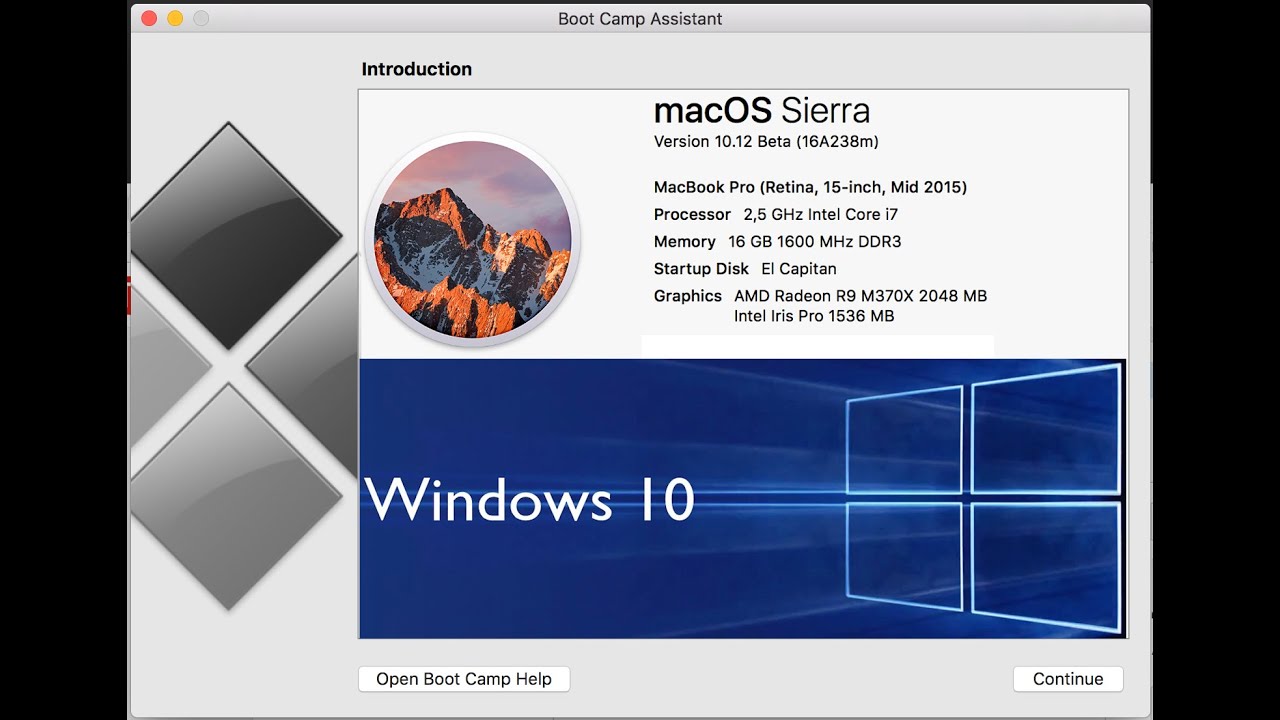
Boot Camp Assistant guides you through installing Windows on your Mac. You just have to follow the onscreen instructions. To launch the Boot Camp Assistant, go to Applications > Utilities folder. Click continue and Boot Camp for Mac will automatically locate the ISO file on your system.
Step 3: Create a partition for Windows
When you are done with the Assistant, your Mac restarts to the Windows installer. When you are asked where you want to install Windows, choose the BOOTCAMP partition and click Format.
*Note that this step is only required if you’re using a flash drive or optical drive to install Windows. In other cases, the right partition will be selected and formatted for you automatically.
Step 4: Install Windows
To finish the installation, you have to follow the onscreen instructions. Take a long breath — the next 12 steps may seem like climbing Everest, but it’s much easier than you think. Here’s how to install Windows on a Mac:
- Choose your ISO file and click the Install button.
- Type your Password and click OK. You will see the Windows Setup screen.
- Select your language.
- Click Install Now.
- Type your product key if you have it. Otherwise, click 'I don’t have a product key'.
- Select Windows 10 Pro or Windows Home and then click Next.
- Click Drive 0 Partition X: BOOTCAMP.
- Click Next. Windows 10 will be installed.
- When the Setup screen appears, click either Use Express Settings or Customize Your Installation. We recommend you to choose the Customize button and disable most, if not all of the switches.
- Then you’ll be asked to create an account. Type a username. You can also add a password if you want.
- Click Next.
- Choose whether you want to use the Cortana personal assistant or not. You can disable it by clicking Not Now button.
Windows will boot fully so you can use it normally.
On the Welcome to Boot Camp Installer box, click Next and accept the terms in the license agreement. Then click Install to proceed. When the installer completes, click Finish to reboot your machine.
Step 5: Restart your Mac
By default, your Mac will still boot to macOS. To access Windows, you have to turn your Mac off and then turn it on while holding the Option (Alt) key. You will be asked from which drive you’d like to boot.
Note that while in Windows, the Mac’s Command key functions as the Windows key, while the Option key functions as the Alt key. If you have a Touch Bar, you’ll see a complete set of buttons, similar to the Control Strip in macOS.
How to remove Windows from your Mac
If for some reasons you don’t need Windows anymore, you can permanently remove it from your Mac. Follow these steps:
- Boot into macOS, launch Boot Camp Assistant and click Continue.
- Choose 'Remove Windows 7 or later version' or 'Remove Windows 10 or later version'.
- Click Restore when you see the Restore Disk to a Single Volume option.
The Boot Camp Assistant will automatically remove Windows from your Mac.
Warning: All data, including software and files, stored on the Windows partition will be deleted, so make the backup copies first.
That may seem like a lot of steps, but it doesn’t take all that long to install Windows on a Mac. Now you can enjoy two operating systems and switch between them right when you need. Cheers!
These might also interest you:
Windows 10 is now the most popular version of Windows. Installing it on Parallels Desktop® for Mac is easy to do—and does not require you to purchase Windows 10 beforehand.
There are four different scenarios you might find yourself in, with slightly different steps:
Scenario 1: You have just installed Parallels Desktop 14 on your Mac®.
Scenario 2: You have Parallels Desktop on your Mac, and you want to add a Windows 10 virtual machine (VM).
Scenario 3: You want to upgrade an existing Windows VM to Windows 10.
Scenario 4: You want to move Windows 10 from a physical PC into a Parallels Desktop VM.
Here are the individual steps for each:
Scenario 1: You have just installed Parallels Desktop 14 on your Mac.
When you first launch Parallels Desktop 14 on a Mac, it will detect that you have no virtual machines and will automatically offer to download and install Windows 10 for you. (See Figure 1.)
Once you click “Install Windows,” there is basically nothing else for you to do. The Windows 10 installation files will begin downloading (Figure 2).
Note: If you click on “Skip” instead, you will be directed to the Installation Assitant where you can purchase Windows 10 (see Figure 8).
Figure 2_Downloading Windows 10
Once the download finishes, the installation of Windows 10 into a new VM in Parallels Desktop will begin (Figure 3).
You will be notified when it completes (Figure 4).
Figure 4_Windows 10 installation complete
How long this process takes depends on the speed of your Internet connection and Mac. For me, at home and on a new MacBook Air®, this took about one hour and 40 minutes.
While Windows 10 is installing, you’ll see dialogs about the installation of Parallels® Toolbox, a separate Parallels product that’s bundled with Parallels Desktop (Figure 5).
Figure 5_Parallels Toolbox, a product that is bundled with Parallels Desktop
Parallels Toolbox gives you 30+ single-purpose tools for common tasks. I encourage you to install Parallels Toolbox—I think you’ll find the tools very useful.
After Windows 10 is installed, you should get all of the available updates, and there probably will be several of them (Figure 6).
This may take a while but is very important.
At this point, you have a working installation of Windows 10 in a Parallels Desktop VM. You have not yet purchased Windows from Microsoft. A few features will be disabled until you do so. You can purchase and activate Windows from within your Windows VM, and the entire process takes only a few minutes (Figure 7).
Figure 7_Purchasing and activating Windows 10
Scenario 2: You have Parallels Desktop on your Mac, and you want to add a Windows 10 VM.
Adding Windows 10 as an additional VM in Parallels Desktop is also easy.
To start the process, either choose “New…” in the File menu of Parallels Desktop, or click on the “+” sign in the top right corner of the Control Center window.
Assuming that you don’t have a Windows 10 installation DVD laying around, click on the “Get Windows 10 from Microsoft” button (Figure 8).
Figure 8_Get Windows 10 button in the Installation Assistant
Then choose to purchase Windows 10 Home or Windows 10 Pro in the next screen. If you want to install Windows 10 without making a purchase yet, choose to download it (Figure 9).
Whichever path you choose, you will end up with a Windows 10 installation ISO file and a Windows 10 product key. After that, everything proceeds in the same manner as scenario 1. (See the previous Figure 2 as an example.) Don’t forget to install Parallels Toolbox and all the available Windows 10 updates!
Scenario 3: You want to upgrade an existing Windows VM to Windows 10.
Use these steps if you have a Windows 7 or 8 VM that you would like to upgrade to Windows 10.
Upgrading an operating system is a task best done with lots of RAM. If possible, upgrade the amount of memory allocated to the VM to 4 GB, using the memory pane of the configuration dialog for the VM you will be upgrading. The VM cannot be running when you do this. Be sure that the RAM allocation slider remains in the green area on the memory scale, not the yellow or red areas (Figure 10).
Figure 10_Increase the memory allocation for the VM that will be upgraded
Two years ago, upgrading Windows 7 or 8 to Windows 10 was free, but that is no longer the case. You now need to pay for this upgrade—at least, this is what everyone thought.
Ed Bott reported on ZDNet in October 2018 that if you upgrade an activated copy of Windows in a specific way, the resulting Windows 10 will continue to be activated. I tried this for a Windows 8.1 VM, and it worked without any problems. Here’s what I did:
PRTG Network Monitor is an all-inclusive monitoring software solution developed by Paessler. Equipped with an easy-to-use, intuitive interface with a cutting-edge monitoring engine, PRTG Network Monitor optimizes connections and workloads as well as reduces operational costs by avoiding outages while saving time and controlling service level agreements (SLAs). The solution is packed specialized monitoring features that include flexible alerting, cluster failover solution, distributed monitoring, in-depth reporting, maps and dashboards, and more. Download latest itunes for mac 10.5.8.
1. Make sure you’re starting with an activated installation of Windows.
2. Download the Media Creation tool from the Download Windows 10 page. You must do this inside Windows, not from a Mac browser.
3. Run the Media Creation tool and choose “Upgrade this PC now” (Figure 11).
Figure 11_Using the Media Creation tool to upgrade to Windows 10
4. If you’re warned about an incompatible Parallels Display Adapter, just confirm that you understand. (Figure 12.)
Figure 12_Don’t worry about this warning if you see it
5. This issue will be taken care of when Parallels Tools reinstalls after the upgrade to Windows 10.
6. The Windows 10 upgrade files will be downloaded, and the install will proceed. Parallels Tools will automatically reinstall.
How To Download Windows 10 For Mac Free Torrent
7. When finished, you will have an activated installation of Windows 10 (Figure 13).
Mac Download For Windows 10
Figure 13_Success! An activated installation of Windows 10
McAfee Endpoint Protection for Mac 2.3.0. (McAfee ePO™) server and the Mac fails, and you would be unable to manage the Mac from the McAfee ePO server. For more information about the McAfee Agent 5.0.2 known issues with El Capitan, see McAfee KnowledgeBase article KB83895. Mcafee endpoint security for mac. McAfee announces the End of Life (EOL) for the following Endpoint Protection for Mac versions. As of the EOL date, McAfee no longer provides Technical Support for the product version. McAfee strongly recommends that customers upgrade to Endpoint Security for Mac. For product versions, see KB84934.
Don’t forget to reset the memory allocation in the upgraded VM. The increased allocation was only needed for the OS installation process.
Scenario 4: You want to move Windows 10 from a physical PC into a Parallels Desktop VM.
In this last scenario, you start out with the Installation Assistant dialog (see previous Figure 8) but choose “Transfer Windows from a PC.” You will then see the Transfer Windows dialog shown in Figure 14.
This process will copy everything from a physical PC to a Parallels Desktop VM: apps, data files, and Windows itself. The physical PC will not be modified.
The most common way to transfer is via the network. The amount of time this will take depends on how much information is on the PC and how fast your network is.
There may be several Windows PCs on your network, so you need to indicate which PC you want to migrate into a VM. Do this by installing the Parallels Transfer Agent on the PC to be migrated.
There are two computers involved in this transfer: the Windows PC you are transferring from, and the Mac running Parallels Desktop which you are transferring to. Some of the actions you’ll take to set up this transfer occur on the PC and others on the Mac, so you will need to go back and forth between the two computers to set everything up. These tasks are not complicated, as shown in this video:
Figure 15.
I hope you’ve seen how easy it is to install Windows 10 on Parallels Desktop. Feel free to download a free full-featured trial of Parallels Desktop and install Windows 10 like explained in scenario 1 right away at no extra cost.
Let us know in the comments below, on Twitter or Facebook which way of installing Windows 10 on your Mac worked best for you.